3.2 M
in funding
Last update: 27/05/2019
Improving women’s livelihoods through an inclusive door‑to‑door sales model
| country | Brazil |
|---|---|
| theme | Legacy Projects |
| status | Terminated |
| Implementation Date |
2012
2019
|
| Budget |
3.2M
|
| Phase | Terminated |
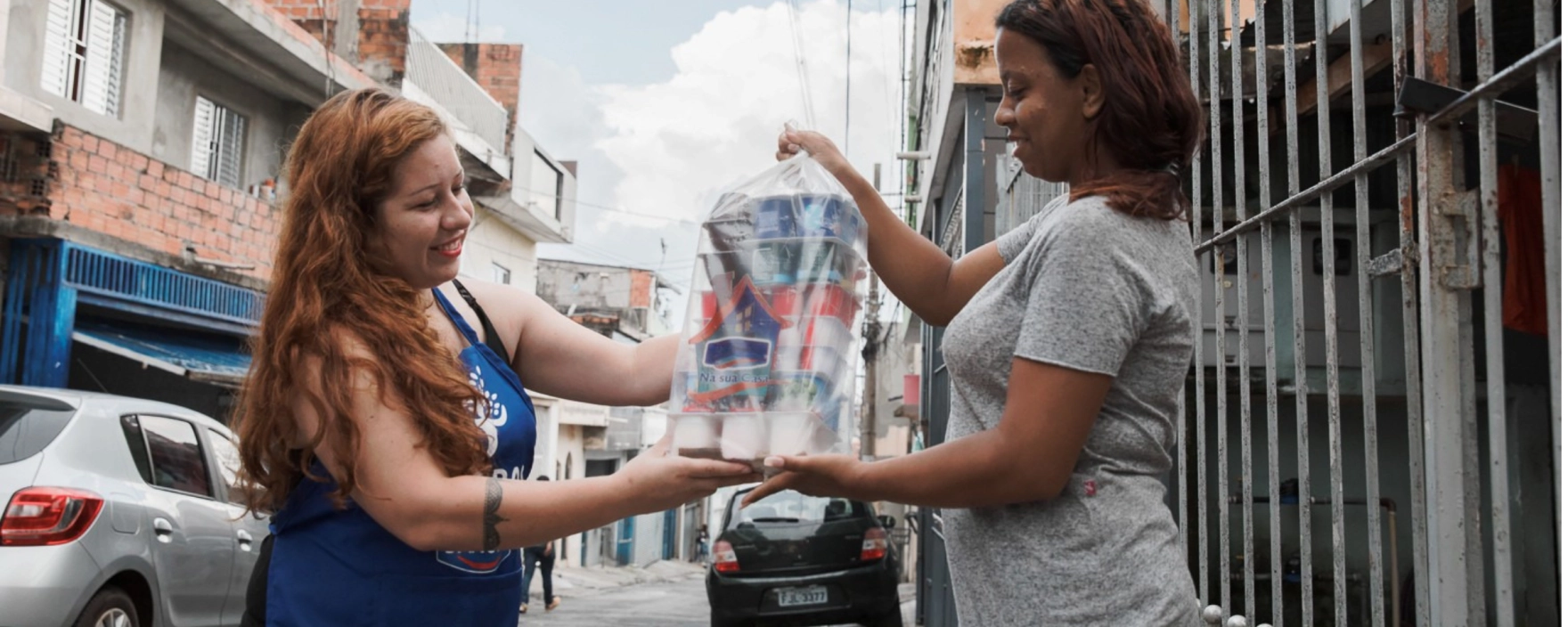
Before structuring our work around today’s key focus areas, Danone Ecosystem developed pioneering initiatives. Among them, our Inclusive Distribution projects played a central role in empowering vulnerable populations and creating opportunities for local entrepreneurship.
These early projects laid essential foundations for our current model: people and their communities are at the heart of everything we do. We strive to build truly sustainable initiatives by training and strengthening the capabilities of key professionals and the communities they serve.
Brazil is marked by high levels of wealth inequality, with women in underprivileged communities among the most affected. Many women, particularly single mothers, face limited access to formal employment and are therefore compelled to rely on informal, low paid and insecure jobs. Low levels of education and insufficient professional training further reduce women’s capacity to access better employment opportunities, concentrating them in a narrow range of undervalued activities, a defining characteristic of female labor in the informal sector.
According to the Brazilian Institute of Geography and Statistics (IBGE), in 2012 informal employment among women accounted for approximately 42.6% of the total employed female population. This lack of stable income opportunities restricts women’s economic independence and reinforces social and economic vulnerability.
Launched in 2012 the Kiteiras project was developed as a direct‑to‑consumer distribution programme dedicated to women from some of Brazil’s poorest communities.
The project created a micro‑distribution network of door‑to‑door vendors, offering women formal income‑generating opportunities close to their homes. Vendors were supported and coordinated by Godmothers, who played a key role in mentoring, professional development, and the recruitment of new participants.
In addition to employment, the project focused on women’s empowerment through targeted training in entrepreneurship, adapted nutrition, and life skills.
By supporting the development of formal economic activities in low‑income areas and empowering women as entrepreneurs, Kiteiras contributed to improved livelihoods while establishing a new, inclusive direct‑to‑consumer distribution channel in Brazil.