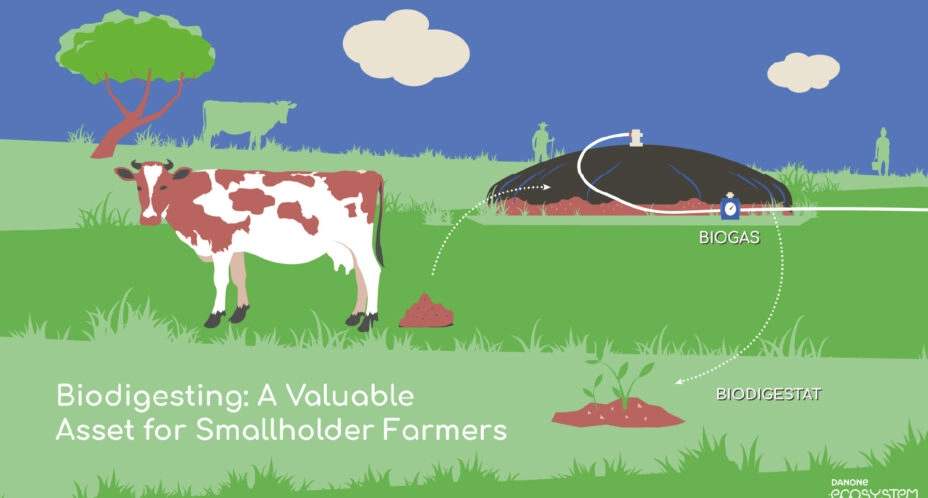
In line with its mission to serve the public interest, Danone Ecosystem is exploring manure biodigesters as a promising solution for smallholder farmers. This growing practice helps to protect nature while supporting farming communities around the world.
But what exactly are they, how do they work, and why do they matter? Let’s dive deep into the topic.
1) What exactly is a biodigester?
A biodigester is a sealed system that can take various forms, such as a tank, pit, airtight container, or airtight plastic bag. It is usually fully or partially buried. The biodigester enables the anaerobic digestion of organic materials such as wastewater, sludge, animal manure mixed with water, and other organic waste in an oxygen-free environment. This process relies on microorganisms to “digest” the matter, known as anaerobic digestion, to produce two valuable outputs:
- Biogas: a methane-rich renewable energy source that can be used for cooking, heating, or power generation
- Biodigestate: a nutrient-rich byproduct containing stabilized organic matter. It is mostly odorless and partially disinfected if properly digested. It can be post-treated or directly reused as an organic fertilizer to enhance soil fertility.

While biodigesters come in different sizes and use various feedstocks, this article focuses on small-scale units designed for smallholder farmers using animal waste as the primary input.
2) What are the benefits?
Biodigesters contribute directly to 12 of the 17 Sustainable Development Goals (SDGs), with strong links to: SDG 3 (Good Health and Well-being), SDG 7 (affordable and clean energy), SDG 11 (sustainable cities and communities), SDG 13 (Climate Action).
These goals are supported through a range of environmental, social, and agricultural benefits enabled by biodigesters.
Environmental benefits:
- Helps avoid deforestation: Replaces firewood with biogas (1m³ of biogas ≈ 4.5 kg of wood).
- Protects clean water: Prevents nutrient runoff from manure that can contaminate groundwater, impact water quality and cause diseases/infections in animals.
- Green electricity production: In certain cases, particularly for larger biodigesters, it is common to use this biogas to produce electricity via a generator.
- GHG Emission intensity Reduction: Reduce methane emissions from manure through the process of methanization.
Social and Health benefits:
- Improved indoor air quality: when farmers use wood as fuel for cooking, replacing it with biogas helps eliminate indoor smoke, thereby improving air quality
- Labor savings: cuts down on the time and burden of collecting firewood.
- Energy access: provides reliable, clean energy that can reduce costs or even generate income.
- Reduces dependency on liquefied petroleum gas: offers an affordable and sustainable alternative to liquefied petroleum gas, helping households to lower their reliance on fossil fuels and avoid price volatility.
- Waste management: safely treats organic waste, cuts odors, improves farm hygiene, and reduces disease risks from waste buildup.
- Cost saving opportunities: farmers may save on or even replace costly fuels like LPG or diesel.
Agricultural benefits:
- Organic fertilizer: the biodigestate can be used as a natural fertilizer for crops and replace chemical fertilizers, which reduces input costs.
3) Are there risks associated with biodigesters?
While generally safe, certain risks need to be managed:
- Digestate safety:if not handled properly, it may still carry pathogens. Caution is needed, especially when using wastewater or untreated manure. In addition, inadequate storage of digestate can lead to the leaching of pollutants into groundwater or the contamination of nearby surface watercourses.
- Biogas hazards: biogas contains hydrogen sulfide (H₂S), a toxic and flammable gas. It must be filtered before use and well managed to avoid toxicity risks.
- Feeding errors: over or under-loading the digester or improper water-to-manure ratios can affect fermentation and performance.
To mitigate these, farmers should follow best practices such as consistent feeding, maintaining correct manure-to-water ratios, and implementing safety measures, such as fencing off the biodigester to ensure that only trained personnel can access the equipment.
4) What does it take to keep a biodigester running efficiently?
Bertrand Guérin, Vice-President of the French Association of Methanizing Farmers (Association des Agriculteurs Méthaniseurs de France), shares key lessons from years of experience, including a notable project in Benin. His message is clear: biodigesters thrive when managed with consistency, care, and a sense of ownership.
He recommends good practices to ensure steady gas production and long-term performance:
1. Proper Feeding Ratios: Stable biogas production depends on consistent feeding. Farmers must adhere to the recommended water-to-manure ratio provided by the biodigester manufacturer. This ratio should be adjusted to local conditions and the system’s specific design. Feeding twice daily is typically recommended to maintain microbial balance, which is essential for sustained gas output.
2. Managing antibiotic use in livestock:Antibiotics can disrupt the microbial activity required for effective fermentation. While treating a single animal has minimal impact, widespread antibiotic use across a herd can cause fermentation failure, leading to a substantial drop in gas production. Careful management of antibiotic use is critical to protect the biodigester’s microbial ecosystem.
3. Retention time: It is important to ensure a sufficient retention time in the digester so that digestion is complete and the digestate is as free from pathogens as possible. This reduces health risks during human handling after the digester and ensures the production of a high-quality fertilizer. Digestion time mainly depends on ambient temperature. In summer season (above 25 °C), the digestion time is approximately 22 to 30 days, whereas in the cooler mid-season (15–25 °C), it ranges from 22 to 40 days.
4. Regular biodigestate discharge: The biodigestate produced should ideally be removed from the recovery tank every two to three days, depends on the tank capacity. This prevents overflow and ensures the biodigester functions efficiently by maintaining its capacity for continuous waste input and biogas production.
5. Daily maintenance for optimal performance: Routine maintenance minimizes energy loss and ensures the biodigester functions efficiently. Key practices include:
- Sedimentation control: Preventing the buildup of solids by creating internal movement within the digester helps break surface crusts and maintain gas flow.
- Hydrogen sulfide (H₂S) filtration: Since H₂S is both toxic and corrosive, filters must be installed and replaced annually to ensure the biogas is safe to use.
- Clamp inspections: Regularly tightening clamps and connections helps prevent leaks that could compromise gas storage and safety.
5) Why do some Biogas projects fail and how can we prevent that?
Based on the feedback from Bertrand Guérin and Sistema Bio’s experiences, some active projects occasionally fail. The success of a biogas project largely depends on the effective management of the digester, which itself relies heavily on the organization of the people operating within the farm.
Here’s what commonly goes wrong and how to fix it:
- Ownership and engagement: Projects often fail due to poor management or lack of user ownership. When farmers contribute significantly to the biodigester’s cost, they are more likely to take responsibility for its upkeep, ensuring consistent feeding and maintenance.
- Preventing common pitfalls: Field experience has also revealed common causes of system failure. For example, some units were damaged by animals due to a lack of fencing. In other cases, inconsistent feeding disrupted gas production, which is often a result of low farmer engagement linked to minimal or no financial contribution.
- Engage stakeholders for long-term viability: The proper functioning of a biodigester is closely tied to the end users of biogas and biodigestate. The involvement of all stakeholders, including farmers and their families, is critical. Their engagement ensures that the biodigester remains a valuable asset, making stakeholder participation a key lever
- Training and Support: Comprehensive training and ongoing support for farmers are both critical. These measures empower farmers and their families with the knowledge and skills needed to operate the biodigester effectively, turning it into a valuable, long-term asset for the farm.

6) A Success story in Indonesia
Danone Ecosystem, through its nature-focused projects in sustainable milk production, co-financed biodigesters for smallholder dairy farmers in Indonesia.
Danone Ecosystem supported the installation of biodigesters during the pilot stage of the Farming Resilience Enhancement for Sustainable Husbandry (FRESH) project, with the objective of helping farmers better manage livestock effluents.
This initiative has benefited farmers by:
- Improving milk safety by reducing bacterial contamination risks through better manure management.
- Minimizing nutrient runoff, particularly nitrogen and phosphorus, to help protect surface water quality and reduce the risk of nutrient pollution.
- Supporting farmers’ transition to sustainable, nature-positive practices that improve resilience and productivity.
By transforming waste into opportunity, this initiative strengthens food safety and farm sustainability.
7) What limitations should be considered when implementing biodigesters?
Biodigesters are not universally applicable and must be carefully adapted to local conditions. They perform best in warm climates while cold temperatures can slow fermentation leading to low biogas yield.
A reliable water source is essential for operation, but it must not come at the cost of environmental health or compete with critical needs like drinking, hygiene, or cooking.
A biodigester must be part of a holistic, sustainable approach that considers the broader environmental context at both local and regional scales. It should be integrated into ecosystems without disrupting biodiversity, soil health, or natural water cycles. Careful site selection and proper management are essential to avoid negative environmental impacts and ensure alignment with the surrounding environment and available resources.
This article was co-written by Danone Ecosystem, the GIZ (German Agency for international cooperation), Sistema Bio, Bertrand Guérin (Vice-President of AAMF, “Association des Agriculteurs Méthaniseurs de France”) and the NGO Energy Assistance.
Sources:
- Obaideen and al (2022), Biogas role in achievement of the sustainable development goals: Evaluation, Challenges, and Guidelines, https://doi.org/10.1016/j.jtice.2022.104207
- GIZ (2015) AGIRE Program, https://www.susana.org/_resources/documents/default/3-2584-7-1466431474.pdf
For further reading:
– Closed-Loop Biodigesters on Small-Scale Farms in Low- and Middle-Income Countries: A Review, (This study provides additional information beyond those presented in the article)(PDF) Closed-Loop Biodigesters on Small-Scale Farms in Low- and Middle-Income Countries: A Review
– Technical sheets IDELE (to gain more detailed information about Biodigesting on a specific area and context, in this case, France):
La méthanisation en élevage bovin : un éventail de possibilités